
 Revenue Cycle Management
 08-Jul-2026
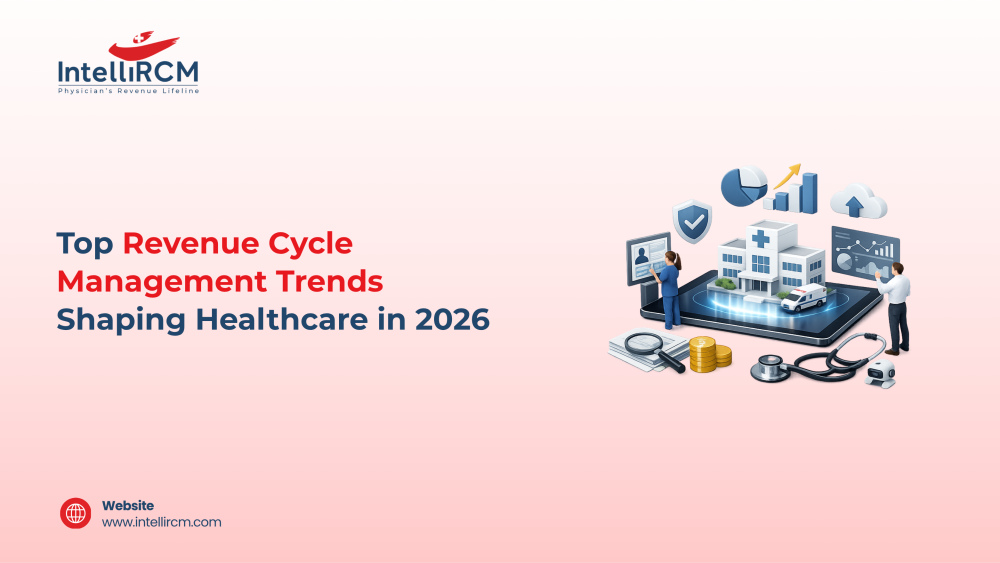
Healthcare finance leaders are entering 2026 under more pressure than ever. Reimbursement models are more complex, staffing shortages haven't let up, and margins remain thin across the board. Hospitals are operating on razor-thin margins - averaging just 1 percent in 2025 - while labor accounts for 56 percent of hospital spending, making it the single largest driver of cost (source: AHA The Cost of Caring 2025). Against this backdrop, revenue cycle management services are no longer a back-office function. They are a strategic lever that determines whether a health system stays financially viable.
More than half of revenue cycle leaders say their operations will become less effective unless they act quickly, pointing to rising denials, aging accounts receivable, and persistent labor and skills shortages as the biggest obstacles to improvement (source: Becker's Healthcare and Savista 2025 RCM Benchmark Survey Report). The organizations pulling ahead in 2026 share a common thread: they are rethinking how billing, collections, cybersecurity, and outsourcing work together as one connected system rather than as separate line items.
Below are the four trends shaping revenue cycle management this year and what they mean for providers evaluating RCM billing services partners.
Artificial intelligence has moved from pilot project to production line inside the revenue cycle. Predictive analytics now flags denial patterns before a claim is even submitted, and Robotic Process Automation is taking over repetitive tasks like eligibility verification, prior authorization, and payment posting. This shift frees staff to focus on higher-value, patient-facing work instead of manual data entry.
One of the clearest signs of this shift is the move from Computer-Assisted Coding toward fully autonomous coding. Over 30 percent of U.S. healthcare organizations are now piloting or planning autonomous coding implementations that automate coding workflows end to end without human intervention (source: GlobeNewswire 2025 Market Report). Confidence in generative AI is climbing just as fast: 92 percent of healthcare leaders believe it will meaningfully improve operational efficiency, and 65 percent expect it to speed up decision-making (source: Deloitte).
Agentic AI is the next frontier. In one survey, U.S. healthcare workers estimated that AI agents could cut administrative burden by up to 30 percent, effectively giving staff back a full day each week (source: 2025 Salesforce survey). The scale of the opportunity is enormous - broad AI adoption across healthcare could generate up to 360 billion dollars in annual savings by reducing waste and streamlining decision-making (source: National Bureau of Economic Research).
None of this technology replaces the need for strong fundamentals. Providers still need reliable denial management services to catch and resolve rejected claims before they erode cash flow, and AI is simply making that process faster and more predictive than manual review ever could.
Healthcare organizations sit on enormous volumes of financial and clinical data, which makes them a persistent target. A staggering 93 percent of healthcare organizations experienced a cyberattack in the past year; three in four suffered disruption to patient care, and 96 percent reported at least two incidents involving the loss or exfiltration of sensitive patient data (source: 2025 Ponemon Healthcare Cybersecurity Report). Third-party risk is a growing part of that picture too, with 74 percent of healthcare breaches now traced back to vendor vulnerabilities (source: EY US Healthcare Cyber Resilience Survey).
Compliance frameworks like HIPAA and PCI DSS remain the floor, not the ceiling. Leading organizations are layering on data encryption, multi-factor authentication, vendor risk management, staff training, and continuous audits to get ahead of threats rather than react to them. For any organization evaluating medical billing solutions or an outsourcing partner, vendor security posture should now be treated as a top-line selection criterion, not a footnote in the contract.
Improving operational efficiency is the top priority for 70 percent of healthcare executives this year, as inflation, reimbursement pressure, and administrative costs continue to climb (source: Deloitte 2025 Global Healthcare Outlook). Disjointed systems and high staff turnover are contributing to slower reimbursements, rising denials, and lower patient satisfaction, which is pushing providers to simplify how billing actually works for the patient on the other end.
Patient-centric billing has become the standard rather than a differentiator. Providers are investing in a modern Patient Statement Service that gives patients real-time access to billing details, flexible payment plans, and clear scheduling options in line with the No Surprises Act. That kind of transparency reduces disputes and speeds up collections while cutting down on the number of administrative touchpoints needed to close out an account.
This same efficiency mindset extends into how care itself is delivered. Providers expanding access through the best telehealth services are also having to rethink billing workflows to keep pace, since virtual visits bring their own eligibility, coding, and reimbursement nuances. Getting the revenue cycle right behind telehealth is quickly becoming as important as the clinical experience itself.
Labor shortages remain one of the biggest threats to a healthy revenue cycle. Sixty-three percent of healthcare providers report staffing gaps in their RCM departments, leading to more errors, slower collections, and greater compliance risk (source: American Academy of Professional Coders). In response, 97 percent of healthcare organizations now outsource at least one RCM function, and 70 percent plan to expand those engagements in the coming year (source: Becker's Healthcare and Savista 2025 RCM Benchmark Survey Report).
The market reflects that momentum. The healthcare RCM outsourcing market surpassed 34 billion dollars in 2025 and is projected to nearly double to 67 billion dollars within four years (source: Research and Markets). While offshore delivery in Asia still represents close to 60 percent of healthcare BPO revenue, nearshore delivery is now growing fastest, with a projected 15 percent compound annual growth rate through 2030 (source: Mordor Intelligence 2025 Healthcare BPO Market Report).
For providers searching for the best RCM management services USA teams can trust, nearshore partners in Latin America offer a compelling mix: real-time collaboration in overlapping time zones, cultural affinity, and deep fluency in U.S. healthcare regulations. Clients working with nearshore models typically see 30 to 50 percent labor cost savings, plus another 15 to 30 percent in efficiency gains from standardized workflows and automation - savings many organizations reinvest directly into their digital RCM transformation.
Ready to reduce denials, cut costs, and modernize your revenue cycle? Schedule a consultation with our RCM billing experts today and see how nearshore-powered RCM services can transform your operations.
As these trends converge, providers need more than a vendor. They need a technology-driven partner built around the realities of 2026. This is where IntelliRCM stands apart. IntelliRCM combines AI-powered automation, proactive cybersecurity protocols, and a nearshore delivery model to help healthcare organizations reduce denials, accelerate collections, and lower operating costs - without asking internal teams to take on more.
IntelliRCM's platform is designed to work across the full revenue cycle, from eligibility and prior authorization through coding, claims, and patient billing. For organizations that want to modernize without a heavy upfront technology investment, IntelliRCM offers a path to faster reimbursements, stronger compliance, and a noticeably better patient billing experience - all while keeping internal teams focused on patient care instead of administrative backlog.
Revenue cycle management in 2026 is being shaped by four converging forces: intelligent automation, proactive cybersecurity, operational efficiency, and a strategic shift toward nearshore outsourcing. Providers that treat these as isolated initiatives will keep falling behind rising denials and shrinking margins. Providers that connect them - through the right technology, the right vendor safeguards, and the right outsourcing partner - are the ones setting the pace for the industry.
The path forward doesn't require doing everything at once. It requires picking a partner who understands where the revenue cycle is headed and can help you get there without disrupting the care you deliver today.
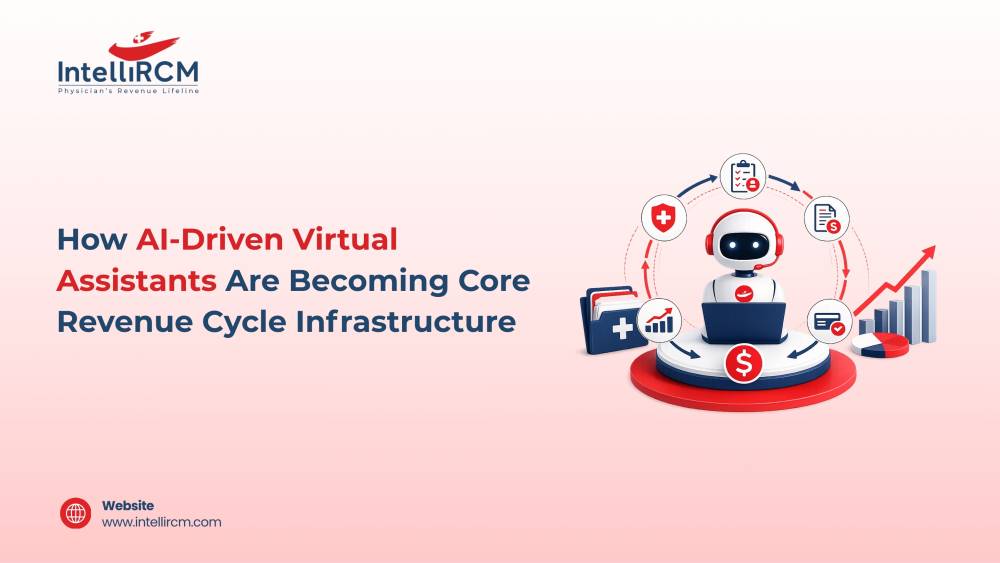
AI-driven virtual assistants are redefining healthcare revenue cycle management. Reduce claim denials, speed up reimbursements, and cut costs. Optimize your RCM today.
Read Full GuidePersistent staffing shortages, rising claim denials, and the need for specialized technology are pushing providers to rely on outsourcing partners who can deliver both scale and expertise.
AI-driven automation, stronger cybersecurity protocols, patient-centric billing, and the rapid growth of nearshore delivery models in Latin America.
Coding, billing, denial management, eligibility verification, patient statements, and collections support are among the most frequently outsourced functions.
It refers to outsourcing revenue cycle functions to providers in nearby regions, most commonly Latin America, that offer overlapping time zones and cultural alignment with U.S. healthcare organizations.
Nearshore partners offer real-time collaboration, faster turnaround, and deep familiarity with U.S. healthcare regulations - advantages that are harder to replicate in traditional offshore delivery models.
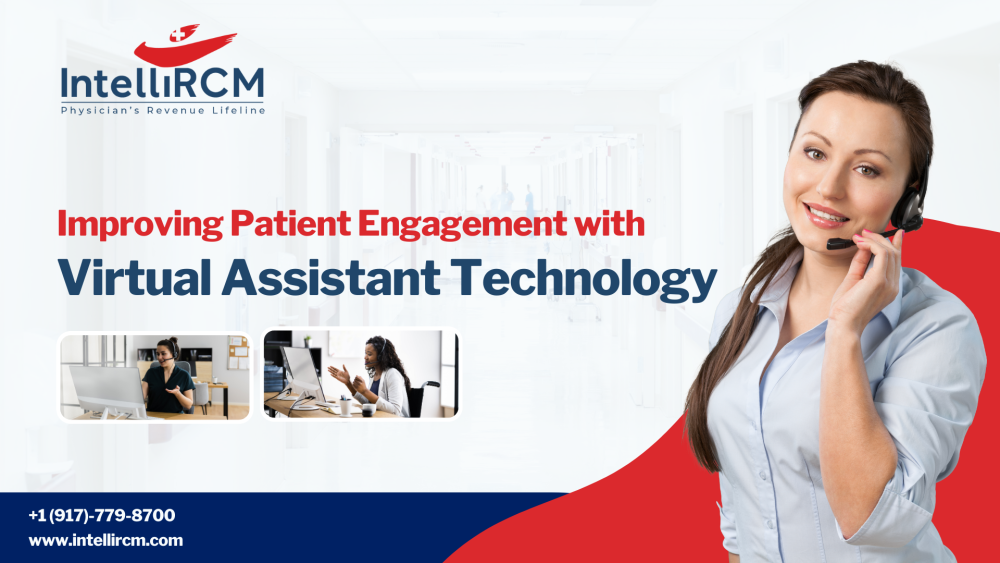
Virtual assistant technology has the potential to revolutionize patient engagement in healthcare, improving access to care, enhancing patient satisfaction, and ultimately driving better health outcomes. By embracing these innovative technologies and addressing the associated challenges, healthcare providers can unlock the full potential of virtual assistants to transform the patient experience and improve the quality of care.
Read More
The transition to value-based care is fundamentally reshaping the healthcare landscape, and RCM is no exception. By embracing data-driven decision making, streamlining workflows, and leveraging the latest technologies, healthcare providers can navigate the complexities of VBC and optimize their RCM processes to achieve improved financial performance, enhanced patient outcomes, and a sustainable future.
Read More
Track key RCM KPIs like denial rate, AR days, and collections to improve cash flow. Learn how expert RCM services boost revenue performance—get started today.
Read More